In this article
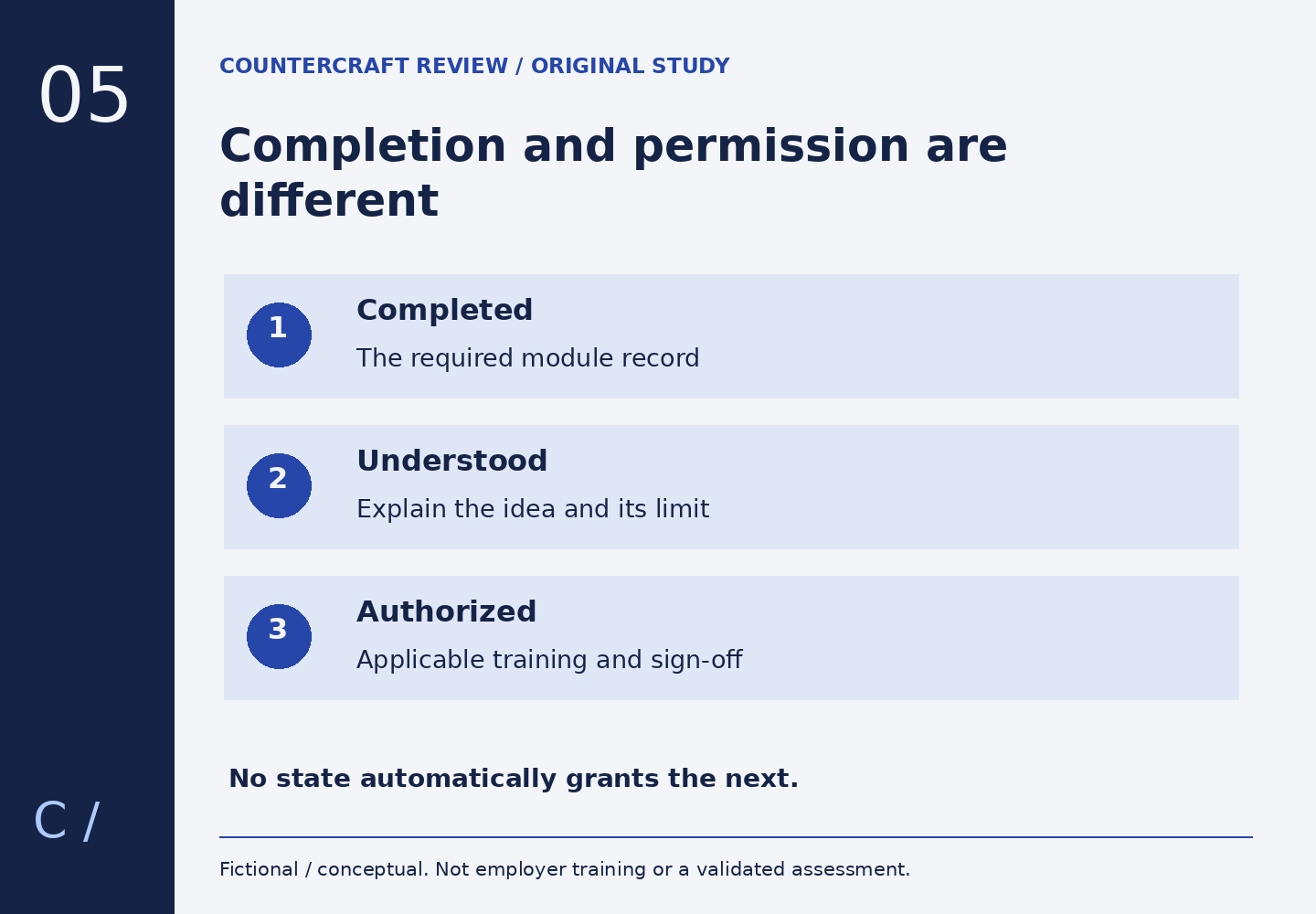
Reaching the final screen of a learning module and understanding how to use its ideas are different outcomes. A completion record may matter for an official requirement, but a learner can also leave with a clearer question, a concept to explain or a permitted practice task. This article concerns learning habits. It does not provide employee-system access instructions or tell readers to copy internal material.
Know what the module is supposed to do
Before beginning an authorized module, identify its stated purpose and any required completion process. Is it introducing vocabulary, explaining a policy or preparing for supervised practice? Those purposes call for different follow-up questions. Do not assume that every module independently authorizes the learner to perform the related work.
In a fictional public course about event organization, one module explains the difference between an announcement and a confirmed change. The learner’s objective is to distinguish those states in an invented example. The course is not a Starbucks system, and the scenario does not represent an actual training assignment.
Pause at a meaningful boundary
A useful pause occurs after a concept or worked example, rather than every arbitrary number of minutes. Ask what the central distinction was and what would change the answer. If the explanation depends on a definition you cannot recall, return to the relevant section. That is a learning action, not a reason to treat the entire module as failed.
The IES educational practice guide discusses retrieval and delayed review. Those principles offer context for checking understanding rather than only rereading. The guide is an educational source from 2007; it does not establish that our suggested habits are a validated training method for Starbucks employees or every workplace task.
Separate notes from copied content
A short personal question can be useful without reproducing a proprietary slide or screenshot. For the fictional course, a note might say “When does an announcement become confirmed?” That captures the learning gap. It does not require storing internal procedures, assessment answers or another person’s data on a personal device.
Follow the training provider’s and employer’s rules about materials, devices and records. Do not use unauthorized tools to record a module, export its content or answer an assessment. If an accessibility barrier prevents learning, use the provider’s appropriate support process rather than bypassing required controls.
Use a different example to check the idea
Remembering the exact example on the screen can feel like understanding the concept. Try applying the idea to a new fictional case. If a room change is proposed but not approved, what information is still missing? If the learner can explain why the answer differs, the check is more revealing than repeating a sentence from memory.
Keep real operational practice within authorization. A concept may be safe to discuss in an invented scenario while actual performance requires equipment training, supervision or formal sign-off. The distinction between learning and permission should remain visible throughout the process.
End with one next step
A useful next step may be to ask a trainer about an unclear exception, revisit a concept later or request appropriate supervised practice. It should not become a vague promise to “study everything.” The public Starbucks growth page establishes broad development context, not a universal requirement to study at home or a guarantee of a specific opportunity.
If the module is required for work, clarify time, recording and completion expectations through the official process. See learning time and work time before treating training as a personal spare-time task. Completion can be a necessary milestone. The additional goal is to know what you understand, what remains uncertain and which authorized next step will help.
Sources and limits
Organizing Instruction and Study to Improve Student Learning. Starbucks Careers: Grow. Public material checked October 8, 2026. Fictional examples and practice structures are original editorial work. They are not employer training, an assessment credential or a promise of a career outcome.