In this article
“Get better at communication” is a direction, not yet a practice task. It is too large to tell you what to try or what to notice afterward. A more useful starting point names one behavior in one situation, with a clear boundary. This publication uses fictional exercises so readers can explore that distinction without involving customers, colleagues or private workplace information.
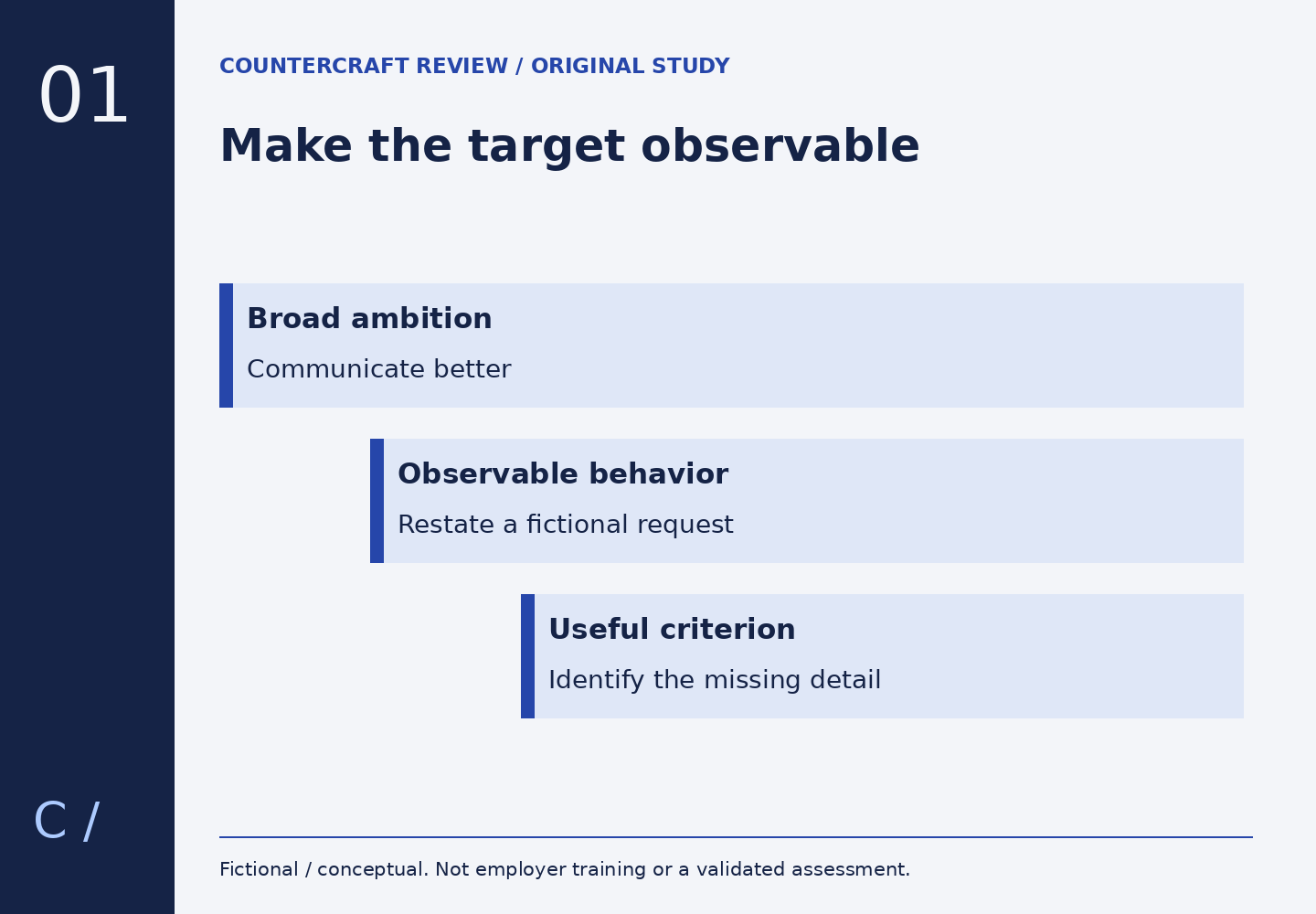
Choose a behavior you can observe
In an invented community-event scenario, a volunteer receives a vague request for supplies. The practice target is to restate the request and ask one question about the missing detail. It is not to become a better communicator in every context. The behavior can be observed: did the explanation accurately reflect the request, and did the question address the uncertainty?
That target is deliberately modest. It does not require a real workplace experiment, a recorded conversation or an evaluation of another person. A reader can rehearse it alone with a written fictional prompt. If practice involves actual work, use approved training materials, appropriate supervision and the applicable workplace process.
Define what counts as a useful attempt
A criterion should describe the behavior rather than a personality trait. “Clear and specific” becomes more useful when translated into “names the item, the needed time and the unresolved quantity.” By contrast, “sounds confident” may reward delivery while overlooking an incorrect assumption. Confidence and accuracy are different things.
In the event example, the fictional request says that materials are needed soon but gives no quantity. A useful attempt should not invent a number. It should identify the missing quantity and clarify what “soon” means. The exercise tests whether the reader notices uncertainty, not whether they can produce the smoothest sentence.
Keep the conditions visible
A quiet rehearsal differs from a busy workplace. So does practicing with a familiar phrase rather than an unfamiliar request. Write down the conditions of the fictional attempt so an easy success is not mistaken for mastery. Later, change one condition at a time: a missing time, an ambiguous item or two competing requests.
The IES learning guide discusses worked examples, retrieval and explanatory questions in educational settings. Those ideas provide background for this editorial exercise. They do not validate our prompts as a workplace training program or establish that a particular amount of practice improves performance at Starbucks. Use the source at its actual level of evidence and audience.
Give feedback a narrow job
After the attempt, compare it with the criterion. If the quantity was invented, that is the useful feedback. There is no need to attach a sweeping label such as careless or naturally talented. The next attempt can focus on asking about quantity before proposing an action. That makes the feedback usable.
If another person participates, agree on the purpose and scope first. Do not surprise a colleague with a test, record them without permission or turn a learning exercise into an unofficial performance review. The feedback article explains how to convert a specific observation into a bounded next attempt.
Stop before the exercise becomes an unauthorized procedure
A rehearsal may reveal a question about the real job. That question belongs with the appropriate trainer or workplace owner. Do not fill the gap with a procedure invented by this website. Food safety, equipment, cash handling, security and other operational work require the official instructions and authorization applicable to the role.
The Practice Prompt Mixer offers original fictional scenarios for listening, organizing and explaining. It supplies a starting prompt and reflection questions, not a score. The useful outcome is a clearer next learning question: what specific behavior is worth practicing, under what conditions, and how will a learner recognize the difference?
Sources and limits
Organizing Instruction and Study to Improve Student Learning. Public material checked October 8, 2026. Fictional examples and practice structures are original editorial work. They are not employer training, an assessment credential or a promise of a career outcome.