In this article
Feedback becomes useful when a learner can tell what to do differently. A broad statement such as “be more organized” may express a real concern while leaving the next step unclear. The task is to ask for a concrete example, identify the behavior involved and agree on a bounded way to practice. It is not to accept every interpretation without question or promise immediate perfection.
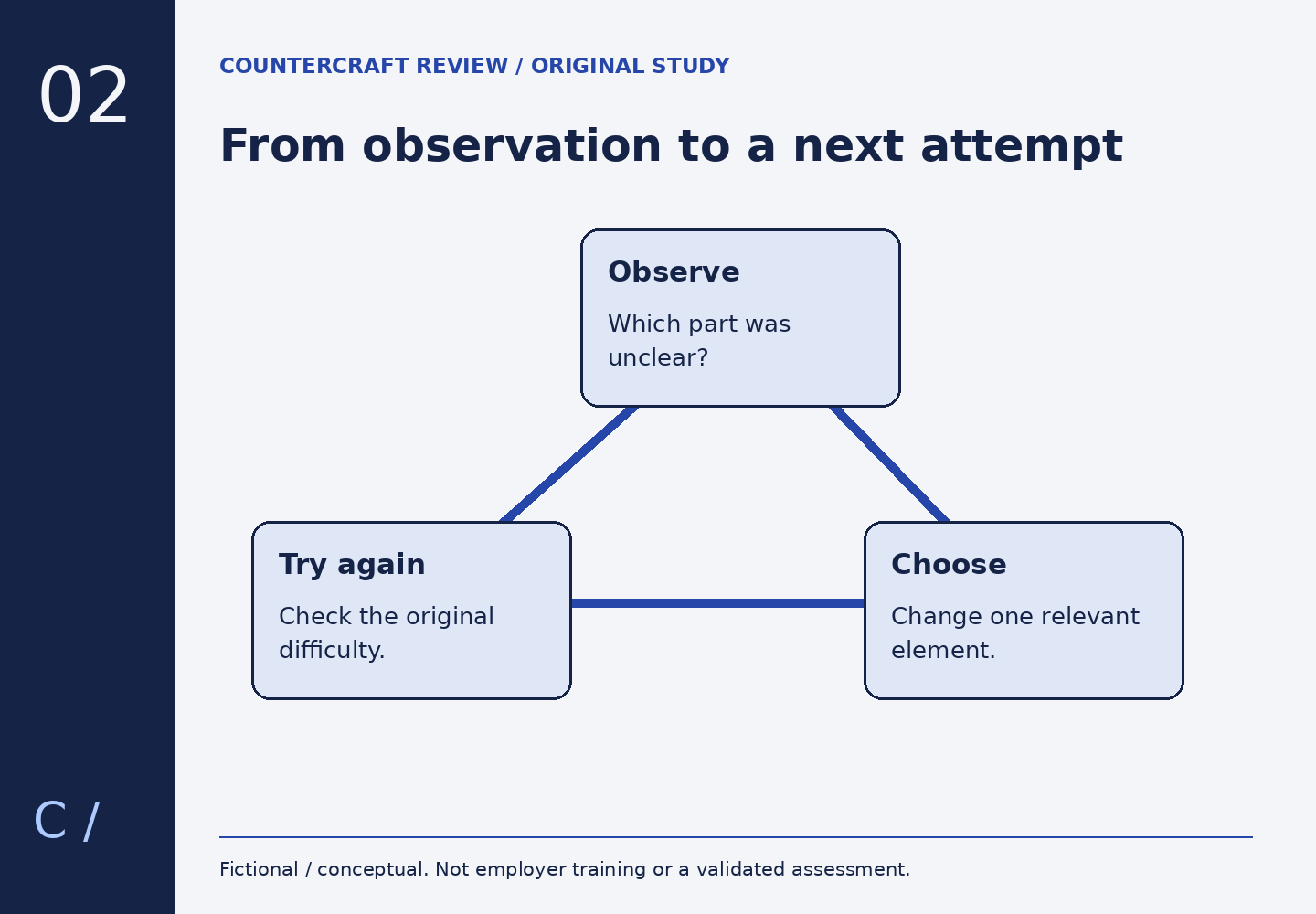
Ask what was observed
In a fictional training exercise, a learner explains how a set of event cards should be sorted. The listener says the explanation was hard to follow. Before redesigning the whole explanation, ask which part caused difficulty. Was the order unclear? Were two categories mixed? Was an important exception omitted? These possibilities lead to different next attempts.
An observation should stay close to what happened. “The exception appeared after the final instruction” is more actionable than “You are confusing.” A learner can acknowledge the first without adopting the second as an identity. Equally, a positive comment becomes more useful when it identifies what worked and why it mattered.
Separate the observation from the explanation
The listener may have noticed a genuine problem and still be uncertain about its cause. Perhaps the wording was unclear, perhaps the materials were incomplete or perhaps the audience lacked a necessary definition. Treat the proposed cause as something to examine, not a fact simply because it accompanies feedback.
For the fictional cards, the learner discovers that two labels were similar. Reordering the explanation might help, but defining those labels could be the more relevant change. The next attempt should address the actual source of confusion as far as it is known. Avoid changing several elements at once if that makes it impossible to understand what helped.
Agree on a small next attempt
A useful plan names the behavior, the setting and the observation to make. In the example: explain the two labels before sorting, use the same fictional cards and ask the listener to identify which label applies to one ambiguous case. This gives the learner a concrete task without claiming a validated experiment or a general performance result.
Real workplace practice requires the appropriate approval, materials and supervision. Do not change customer-facing procedures, safety checks or operational settings merely to test an idea from a website. If the feedback concerns an official procedure, return to the current authoritative training source and ask the responsible trainer to clarify it.
Keep the relationship proportionate
A feedback conversation is not automatically a formal evaluation, and a formal evaluation may have consequences beyond a casual practice exchange. Know which conversation you are in. If the discussion involves pay, discipline, discrimination or another serious issue, use the relevant workplace or qualified support route rather than reducing it to a personal practice exercise.
Starbucks’ public growth page describes development in broad terms. It does not establish how a particular feedback meeting must be conducted or promise that a specific learner will receive an opportunity. Our fictional examples are editorial exercises, not reports from Starbucks employees or representations of an internal review process.
Close with the learning question
After a practice attempt, ask whether the original difficulty changed. If the listener still cannot distinguish the labels, a clearer definition may be needed. If the labels are now clear but the sequence remains confusing, that is a new, narrower question. Progress can be a better diagnosis of the learning need, even before the whole task feels easy.
Record only an appropriate, non-sensitive summary for yourself if permitted. You do not need recordings, customer details or internal screenshots to remember “define the categories before explaining the sequence.” A useful feedback loop ends with something the learner can actually try, and with honest limits on what one attempt can show.
Sources and limits
Starbucks Careers: Grow. Public material checked October 8, 2026. Fictional examples and practice structures are original editorial work. They are not employer training, an assessment credential or a promise of a career outcome.