In this article
Career progression is often drawn as a ladder of titles. That picture can hide the more useful question: how does the work change? A role may require different decisions, a wider span of responsibility or accountability for other people’s work. Comparing those differences helps a reader prepare questions without assuming that the next title is an automatic reward for time served.
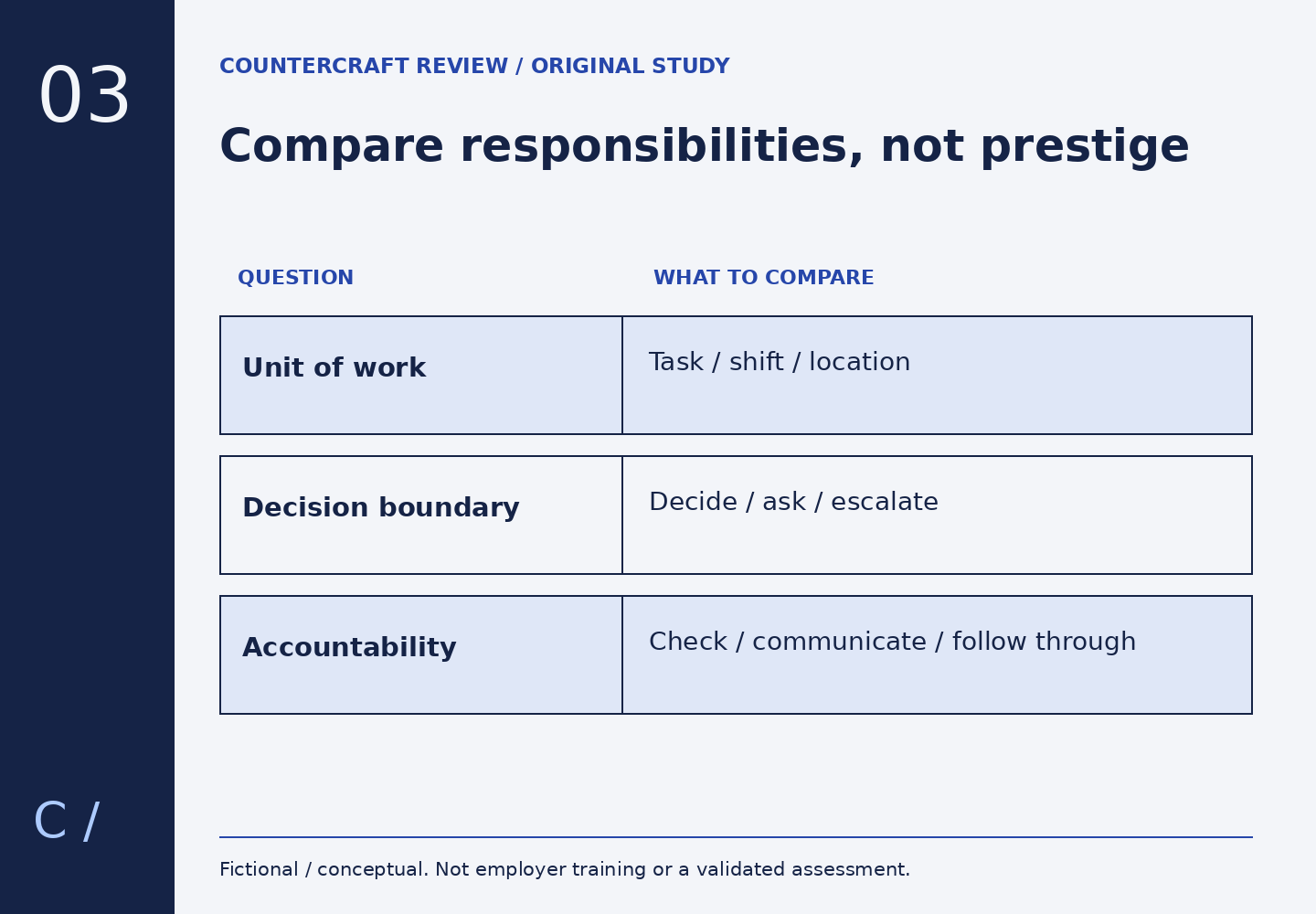
Compare the work, not the prestige
The public Starbucks coffeehouse careers page distinguishes barista, shift supervisor, assistant manager, store manager and district manager roles. Its descriptions indicate changes in scope, including leading shifts and managing broader operations. Those summaries are a starting point for inquiry, not a complete job description or a decision about an individual reader’s eligibility.
In a fictional comparison, one role focuses on carrying out an assigned task accurately, while another coordinates several tasks and responds when priorities conflict. The second is not simply “more of the first.” It requires understanding dependencies and decision boundaries. A learner can explore those differences without pretending to hold authority they have not been given.
Look for three kinds of change
First, examine the unit of responsibility: an individual task, a shift, a location or a wider group. Second, examine decisions: which choices are made independently, which require escalation and which remain outside the role. Third, examine accountability: what must be checked, communicated or followed through because others depend on it?
These are original comparison questions, not Starbucks promotion criteria. O*NET’s retail-supervisor occupation page offers a broader occupational reference, but it also does not describe every employer or location. Use public occupational descriptions to expand vocabulary, then consult the current role posting and authorized workplace guidance for the actual requirements.
Separate interest from readiness
A person can be interested in a role before they are ready for all its responsibilities. That is a normal starting point for a development conversation. Identify which aspect attracts you: coaching, organizing work, understanding operations or another concrete activity. Then ask what experience would help you understand that aspect more accurately.
Avoid treating enthusiasm as evidence that every condition fits. Working pattern, location, responsibilities and personal priorities may matter. A higher title can be a poor fit for someone’s current goals, and staying in a role while developing depth can be a legitimate choice. This publication does not rank those choices for an individual.
Ask for an authorized learning opportunity
A useful request might be to understand a role’s decision process through approved observation or training. The request should state what you hope to learn and ask what is appropriate. It should not assume access to personnel information, financial records, scheduling controls or other restricted material.
In the fictional example, a learner wants to understand how competing tasks are prioritized. An authorized trainer could use an invented scenario rather than exposing a live roster or employee issue. The learning goal is to understand the reasoning, not to collect internal artifacts for a portfolio. See evidence without workplace records for that boundary.
Keep the next step conditional and concrete
After reviewing the role, a useful next step might be a question about prerequisites, a permitted practice opportunity or a follow-up conversation. It is not a guaranteed promotion date. Hiring needs, requirements and individual assessment remain with the employer’s actual process.
A role comparison is successful when it replaces a vague aspiration with a clearer picture of the work and an honest account of what remains unknown. The career-conversation guide helps turn that picture into a focused discussion without inventing commitments on either side.
Sources and limits
Starbucks Careers: Coffeehouses. O*NET OnLine: First-Line Supervisors of Retail Sales Workers, 41-1011.00. Public material checked October 8, 2026. Fictional examples and practice structures are original editorial work. They are not employer training, an assessment credential or a promise of a career outcome.